Posts

fortitude - Tuesday 1st week Easter

We continue to reflect on the four hinges of moral life or the four cardinal virtues.  Last week we reflected on the necessity of prudence, the auriga virtutum , the charioteer of the virtues because  it concerns itself with doing the right thing, at the right time and in the correct manner.  The second cardinal virtue which we will look into is the virtue of Fortitude.  Many times we translate this virtue as courage but it is different from the courage we know today.  Today we understand courage as, kon pala-away, kay man maisog; kon lumumpat sa bungee jump, kay man maisog; kon nagpatunga sa dagat kag nalumos, kay man maisog; kaskasero sa dalan, gani maisog nga driver .  No, fortitude and real courage is different.  This virtue allows us to overcome fear and to remain steady in our will and resolve in the face of obstacles - yes, but it is always reasoned, it is always reasonable.  The person exercising fortitude does not seek danger for ...
Paschal Triduum 2014

Image
Holy Thursday As we begin our celebration of the greatest of all feasts allow me first to remind you that we are celebrating an anniversary.  This is not a simple commemoration but an anniversary.  We can commemorate something anytime of the year – we can commemorate the death of a loved one anytime of the year or a wedding anytime we like.  But to celebrate it as an anniversary we have to more or less approximate it to the exact day and time it happened.  It may not be very precise but it has to come approximately within the time it happened.  What are these anniversaries which we are celebrating beginning today?

prudence - holy tuesday

Today we look into the first of the Cardinal Virtues, the virtue of prudence.   In Christian art it is represented by a woman holding a mirror because a mirror represents truth and self-reflection.   Sometimes prudence is depicted by a snake, because the snake is the symbol of wisdom.   What is prudence?   Prudence is called the auriga virtutum – the charioteer of the virtues.   It is called the charioteer because the cardinal virtue of prudence concerns itself with the action to be taken in a particular circumstance and how that particular action is to be carried out in that particular circumstance.   Simply said it is doing the right thing, at the right time and in the correct manner – that is prudence.   It concerns itself with the what, when, where and how of virtue. Ask yourself the following – what is the good action – to visit the sick; when are you going to visit the sick, surely not during office hours when you are expected to do your d...

what do I believe? Funeral

Image
Jesus said to Martha, “I am the resurrection and the life; whoever believes in me, even if he dies, will live, and everyone who lives and believes in me will never die.  Do you believe this?” She said to him, “Yes, Lord.  I have come to believe that you are the Christ, the Son of God, the one who is coming into the world.” It is in situations like this, and I am sure that there are many situations in our lives similar to this, when the Lord would propose something and ask the same question he asked Martha, do you believe this?

the cross - Tuesday 6th week Lent

Image
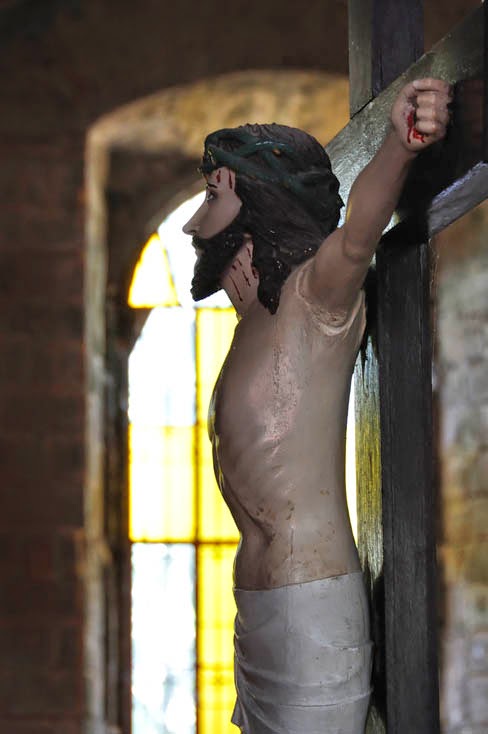
As we approach the Holy Week of the Passion of the Lord, the plot in our gospels, so to say, thickens.  The controversies are no longer just murmured at the background or at the sidelines.  Now they are expressed openly inviting further hostility between Jesus and the Pharisees.  Today another controversy cropped up and the Lord is correct when he said that the Jews opposed to him could no longer follow – where I am going you cannot come, you cannot follow.  And where is he going?  Jesus says that he is going to be lifted up, referring to his passion, referring to his suffering and cross and, he added, only there will people realize that he is the I Am, only there on the cross will people realize that he is indeed God.  Kon nagsiling lang sia kuntani, I am going to be lifted up on the cross and die like a criminal, the Jews can very well understand that.  Siguro masiling sila, OK go ahead, we don’t like you anyway, you are a criminal to our rel...

siete virtudes - Tuesday 5th week Lent

Today, in our series of reflection on virtues, let us take a look at the so called cardinal virtues.   The siete virtudes in our processions and the four women in Church art would often remind us of these virtues.   One can see this in the sanctuary of the Jaro cathedral or in the procession of the siete birtudes sa reyna Elena ukon sa flores de mayo.   A woman holding a pillar reminds us of the virtue of fortitude.   A woman holding a scale or balance reminds us of the virtue of justice.   A woman holding a pitcher reminds us of the virtue of temperance.   And a woman holding a mirror reminds us of the virtue of prudence.   These are the four cardinal virtues as listed in thebible, in the book of Wisdom.   The word cardinal comes from the Latin word cardo meaning the hinge, ang besagra on which all the other virtues pivot and are attached.   Ining apat ka mga birtud daw mga besagra kon sa diin na-angot kag nagalibot ang puertahan. ...

misera et misericordia - Saturday 4th week Lent

Image
When Jesus straightened up there was no one left except just the two of them, the adulterous woman and Jesus.  St. Augustine commenting on this passage said, only two are left standing misera et misericordia – duha na lang ang nabilin nga nagatindog, ang makaluluoy kag ang maluloy-on , the miserable and the merciful, misery and mercy. This passage has a curious history because it cannot be found in many ancient bibles, and if it is found, it is found elsewhere, like in another gospel or in another chapter.  It is said that there were attempts to remove the passage and when people wanted to put it back again, they do not know where to place it?  So why would people want this removed?  Because there are some who think that the gospel passage goes easy with sinners, and that the gospel passage is soft on justice.  Basi magdumdum ang iban nga pirme lang excuse, pirme lang patawad, pirme ok ok lang.

allowing ourselves to be led - Saturday 4th week Lent

It is very difficult to understand who Jesus is when he does not live up to our expectations.   It is difficult to understand who God is when he reveals himself contrary to what we think he should be.   It is difficult to follow God and accept his will when these are not according to what we want, when these are not according to what we desire. The Pharisees had a hard time believing and coming to terms with the person of Jesus because they are already close to their idea of who the messiah is and what he should do.   They are no longer open to other probabilities about his person, they were afraid to venture to the other possibilities of the divine will.   Even the prophet Jeremiah in our first reading grappled with his understanding of what God wanted from him.   He became confused for a while.   But in the end he learned to open himself, he allowed himself to be led meekly like a lamb rather than resist.

we hold on because of a promise - Monday 4th week Lent

Image
Our first reading speaks of that time when there will always be rejoicing and happiness in whatever God does.  It speaks of the new heavens and the new earth, of a time when there will be no more weeping and no sound of crying can be heard.  There shall be no more untimely death, no more unexpected death.  This is difficult to believe especially when we are in the presence of death itself.  This is difficult to preach especially when are still in grief. Our gospel today however, pushes us to go the extra mile in believing.  Jesus healed the official’s daughter from a distance.  Sang nangayo ang tatay nga ayuhon ang iya bata, ang Ginoo wala nagkadto sa balay sadtong opisyal, sa baylo ginsingganan lang niya sia “Lakat ka.”  Kag dugang diri nagsiling ang ebanghelyo nga ang tatay nagtuo sa pulong ni Jesus kag naglakat.  Iya ginsaligan ang ginhambal ni Jesus. He did not give immediate evidence to the miracle he was performing.  He did no...

God's good made visible thru you - 4th Sunday Lent A

The word lent comes from German word lenz which literally means spring.   The root from which the word lenz is derived means long, malaba .   This is because in spring the days become longer.   Have you noticed that – the days are becoming longer.   K ag kon ma-notice pa gid ninyo, as the days become longer in the season of lent the gospel is also becoming longer and longer until we reach the longest in Palm Sunday and also in Good Friday.   Our gospel today is supposedly very long because it is a story full of details.   But I know you are busy people so I just got an excerpt which is the first part of the gospel.   In this first encounter the disciples were asking Jesus, What is the cause of this man’s blindness, was it his own personal sin or was it the sins of his parents?